According to Belleville, the Illinois House is proposing a $500 state income tax credit for fuel-efficient vehicles in 2007 and 2008. In order to qualify, the vehicle would need to get 35 mpg (gas, diesel, or hybrid) or 25 mpg for flexible-fuel vehicles.
Apparently, the state legislatures were listening when Bush gave his State of the Union address. Bush charged that America was addicted to oil. Minnesota wants to produce plug-in vehicles and Missouri has a tax break bill pending.
Belleville News-Democrat
Wednesday, 12 April 2006

Convert a Mini-Cooper into a plug-in hybrid
The Castagna Milano's Mini Cooper hybrid conversion retains much of the orginal engine. They strengthen the suspension system and fit an electic motor to the rear of the vehicle. This allows the driver to switch to all electric with a switch on the dashboard whenever he wants.
The batteries are guaranteed for a period of 5 years and they can be fully charged in 6 hours through a domestic power outlet.
The real problem is the cost:
I saw this story at evworld being quoted at autospies.
The batteries are guaranteed for a period of 5 years and they can be fully charged in 6 hours through a domestic power outlet.
The real problem is the cost:
The cost for the conversion is about 40,000 euros plus the cost of the Mini. Unfortunately they have to do the stretch to have the space for the batteries and that alone costs 19,500 euros. So the hybrid part costs 20,000, of which they say 11,000 is for the battery pack.
Based on the current conversion rate of Euros to dollars, that's more than $48,000 for the conversion and more than $13,000 for the ZEBRA battery.
I saw this story at evworld being quoted at autospies.
Tuesday, 11 April 2006
Missouri ponders tax break for hybrids
Missouri has a bill pending that would allow Missourians hybrid buyers to earn a credit worth either 10 percent of the cost of the vehicle or $1,500, whichever is less. The bill would last for six years, but has yet to be passed off to the Senate.
Missouri has been struggling to keep auto manufacturers in state. With both GM and Ford threatening cuts across the board, state legislatures have been making moves to entice the auto makers to stay. For instance, Minnesota has been attempting to keep auto makers in state by investigating how to convert their plant into a PHEV production plant.
Missouri, in the meantime, passed a bill that would waive the state's 4.225 percent sales tax for all vehicle models built in Missouri. Critics are unsure how the recent bill would help keep jobs in Missouri, however, since the credit applies to hybrids no matter where they are built.
News Tribune
Missouri has been struggling to keep auto manufacturers in state. With both GM and Ford threatening cuts across the board, state legislatures have been making moves to entice the auto makers to stay. For instance, Minnesota has been attempting to keep auto makers in state by investigating how to convert their plant into a PHEV production plant.
Missouri, in the meantime, passed a bill that would waive the state's 4.225 percent sales tax for all vehicle models built in Missouri. Critics are unsure how the recent bill would help keep jobs in Missouri, however, since the credit applies to hybrids no matter where they are built.
News Tribune
2008 Toyota Prius to get 94 mpg
According to the UK's Auto Express, Toyota is attempting to improve the Prius in its next generation. Not only are they hoping to improve its 10.9 second 0-62 acceleration by a second, they are also hoping to improve its mileage to 94 mpg!
Most of the improvements will come from switching the battery from a nickel metal hydride (NiMH) to lithium cells. They will be streamlining the whole electrical system in order to up the ante in the hybrid tech world.
Hybrids have not been as successful in Europe as they have been in North America. A recent poll indicated less than half of Britons know what a hybrid is. In Europe, diesel engines has become the success stroy, while hybrids have fallen behind.
Auto Express
Most of the improvements will come from switching the battery from a nickel metal hydride (NiMH) to lithium cells. They will be streamlining the whole electrical system in order to up the ante in the hybrid tech world.
Hybrids have not been as successful in Europe as they have been in North America. A recent poll indicated less than half of Britons know what a hybrid is. In Europe, diesel engines has become the success stroy, while hybrids have fallen behind.
Auto Express
Monday, 10 April 2006
57% of Americans would consider buying a hybrid
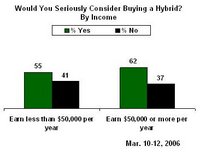
According to a recent Gallup poll, 57% of Americans would consider buying or leasing a hybrid when they next purchase a car. Upper-income Americans are slightly more likely than lower-income Americans (62% vs. 55%) to say they would seriously consider buying a hybrid when purchasing their next car.
 Younger (64%, age 18-49) and middle aged (55%, age 50-64) Americans are more likely to consider hybrids than seniors (39%).
hybrids appeal much more to younger and middle-aged Americans than to seniors. Sixty-four percent of adults aged 18 to 49 say they would seriously consider a hybrid for their next car. This is only slightly lower (55%) among those 50 to 64, but drops to 39% among those aged 65 and older.
Lower income Americans have been cutting back on driving due to gas prices. When making less than $50,000 a year, 59% of the respondents said they had cut back on driving, while only 36% of those making $50,000 or more have cut back. But 48% of those in the upper income bracket have cut back in other areas due to gas prices, while 60% of lower income have made cuts elsewhere in their spending.
Gallup poll
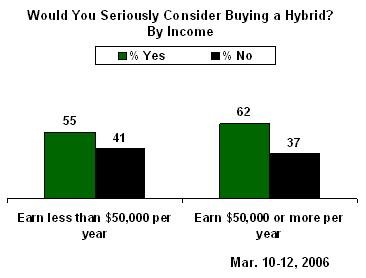 Younger (64%, age 18-49) and middle aged (55%, age 50-64) Americans are more likely to consider hybrids than seniors (39%).
 hybrids appeal much more to younger and middle-aged Americans than to seniors. Sixty-four percent of adults aged 18 to 49 say they would seriously consider a hybrid for their next car. This is only slightly lower (55%) among those 50 to 64, but drops to 39% among those aged 65 and older.
Lower income Americans have been cutting back on driving due to gas prices. When making less than $50,000 a year, 59% of the respondents said they had cut back on driving, while only 36% of those making $50,000 or more have cut back. But 48% of those in the upper income bracket have cut back in other areas due to gas prices, while 60% of lower income have made cuts elsewhere in their spending.
Gallup poll
Saving money by buying a hybrid
A recent poll cited 'saving money' as one of the primary reasons consumers would purchas a hybrid vehicle. Most likely, however, those savings will not be in the short term.
Despite the focus of the press release (see below), only 19% of consumers think of saving money when buying a hybrid. 47% simply want to improve their mileage. 22% want to help the environment.
There are many reasons for buying hybrids, and cost savings is usually not the primary reason. Most buyers of hybrids go into the dealership with their eyes wide open. Usually, they know more about the vehicles and the issues surrounding them better than the salesman.
Press Release Source: PEMCO Insurance
PEMCO's Northwest Insurance Poll Reveals Most Washington Residents Believe Owning a Hybrid Will Save Money; Research Shows Owners Will Have to be Patient
SEATTLE, April 10 /PRNewswire/ -- Most new-car buyers in Washington who are likely to buy a hybrid share a common misconception that owning a hybrid car will save them money through better mileage, according to PEMCO's Northwest Insurance Poll. The reality is that while the increased purchase cost of a hybrid can be offset in gas savings, it can take up to five years before the savings pencil out, according to published reports.
PEMCO's poll data shows that 47 percent of drivers who plan to purchase a new car in the next year, and who are likely to buy a hybrid, report the primary reason they would buy a hybrid is to improve gas mileage. Twenty-two percent say their primary reason would be to save the environment, while 19 percent specifically said "to save money."
"New-car buyers can consider hybrids because they reduce pollution and save the environment, but they shouldn't expect to save money in the short-term," said Jon Osterberg, PEMCO's spokesperson. "Our poll data uncovered false expectations. Forty-four percent said a hybrid would cost less than a conventional car to drive and maintain."
Consumers should be aware that in a recent study commissioned by the nation's leading consumer magazine, only two of six hybrid cars that were tested recovered the price premium in less than five years. Five years is also the typical period of car ownership, according to the magazine.
In the coming months and years, virtually every car manufacturer has plans to introduce a hybrid car model. In 2005, hybrid cars accounted for 1.2 percent of auto sales -- more than double its market share from 2004. Auto manufacturers are having a hard time keeping them on the lot.
Those looking to save money by purchasing a hybrid car need to know that hybrids can cost anywhere from $2,000 to $8,000 more than their gas-powered counterparts.
The timing of a hybrid car purchase also plays into savings. To help ease higher initial fees, new hybrid car owners currently can take advantage of federal tax credits ranging from $650 to $3,150. Consumers should know that after each manufacturer sells 60,000 hybrid units, regardless of model, the credits gradually will be phased out.
In most cases, the tax credits offered on hybrids, combined with money saved on gasoline, are not enough to recover the purchase price during the first several years of owning the car.
Despite the perceived cost savings, over half of Washington's residents who plan to purchase a new car this year do not plan to purchase a hybrid, according to PEMCO's poll data.
"With such rapid growth of the hybrid car market, it's important for consumers to have realistic expectations. Hybrid cars can save owners money, but not as soon as most people think," said Osterberg.
Other poll observations:
-- Older drivers (age 35+) in Washington state are more likely to
purchase a hybrid car than younger drivers (ages 18 - 34).
-- 46 percent of Washington drivers who are likely to purchase a hybrid
in the next year have a college degree, 37 percent report having some
college or technical education, and 24 percent have no college
education.
-- Washington state drivers who own their home, and plan to purchase a
new car in the next year, are almost twice as likely to purchase a
hybrid car as those drivers who rent their home (43 percent of owners
compared to 23 percent of renters).
Anyone wanting to compare their answers with respondents to the PEMCO Northwest Insurance Poll can do so by visiting www.pemco.com, where complete results are posted.
About the Poll
PEMCO Insurance commissioned the independent, statewide survey that asked Washington homeowners several questions about automobiles and other issues.
Informa Research Services Inc. of Seattle conducted the poll. The sample size, 606 respondents, yields an accuracy of +/- 4 percent at the 95 percent confidence level. In other words, if this study was conducted 100 times, in 95 instances the data will not vary by more than +/- 4 percent.
Despite the focus of the press release (see below), only 19% of consumers think of saving money when buying a hybrid. 47% simply want to improve their mileage. 22% want to help the environment.
There are many reasons for buying hybrids, and cost savings is usually not the primary reason. Most buyers of hybrids go into the dealership with their eyes wide open. Usually, they know more about the vehicles and the issues surrounding them better than the salesman.
Press Release Source: PEMCO Insurance
PEMCO's Northwest Insurance Poll Reveals Most Washington Residents Believe Owning a Hybrid Will Save Money; Research Shows Owners Will Have to be Patient
SEATTLE, April 10 /PRNewswire/ -- Most new-car buyers in Washington who are likely to buy a hybrid share a common misconception that owning a hybrid car will save them money through better mileage, according to PEMCO's Northwest Insurance Poll. The reality is that while the increased purchase cost of a hybrid can be offset in gas savings, it can take up to five years before the savings pencil out, according to published reports.
PEMCO's poll data shows that 47 percent of drivers who plan to purchase a new car in the next year, and who are likely to buy a hybrid, report the primary reason they would buy a hybrid is to improve gas mileage. Twenty-two percent say their primary reason would be to save the environment, while 19 percent specifically said "to save money."
"New-car buyers can consider hybrids because they reduce pollution and save the environment, but they shouldn't expect to save money in the short-term," said Jon Osterberg, PEMCO's spokesperson. "Our poll data uncovered false expectations. Forty-four percent said a hybrid would cost less than a conventional car to drive and maintain."
Consumers should be aware that in a recent study commissioned by the nation's leading consumer magazine, only two of six hybrid cars that were tested recovered the price premium in less than five years. Five years is also the typical period of car ownership, according to the magazine.
In the coming months and years, virtually every car manufacturer has plans to introduce a hybrid car model. In 2005, hybrid cars accounted for 1.2 percent of auto sales -- more than double its market share from 2004. Auto manufacturers are having a hard time keeping them on the lot.
Those looking to save money by purchasing a hybrid car need to know that hybrids can cost anywhere from $2,000 to $8,000 more than their gas-powered counterparts.
The timing of a hybrid car purchase also plays into savings. To help ease higher initial fees, new hybrid car owners currently can take advantage of federal tax credits ranging from $650 to $3,150. Consumers should know that after each manufacturer sells 60,000 hybrid units, regardless of model, the credits gradually will be phased out.
In most cases, the tax credits offered on hybrids, combined with money saved on gasoline, are not enough to recover the purchase price during the first several years of owning the car.
Despite the perceived cost savings, over half of Washington's residents who plan to purchase a new car this year do not plan to purchase a hybrid, according to PEMCO's poll data.
"With such rapid growth of the hybrid car market, it's important for consumers to have realistic expectations. Hybrid cars can save owners money, but not as soon as most people think," said Osterberg.
Other poll observations:
-- Older drivers (age 35+) in Washington state are more likely to
purchase a hybrid car than younger drivers (ages 18 - 34).
-- 46 percent of Washington drivers who are likely to purchase a hybrid
in the next year have a college degree, 37 percent report having some
college or technical education, and 24 percent have no college
education.
-- Washington state drivers who own their home, and plan to purchase a
new car in the next year, are almost twice as likely to purchase a
hybrid car as those drivers who rent their home (43 percent of owners
compared to 23 percent of renters).
Anyone wanting to compare their answers with respondents to the PEMCO Northwest Insurance Poll can do so by visiting www.pemco.com, where complete results are posted.
About the Poll
PEMCO Insurance commissioned the independent, statewide survey that asked Washington homeowners several questions about automobiles and other issues.
Informa Research Services Inc. of Seattle conducted the poll. The sample size, 606 respondents, yields an accuracy of +/- 4 percent at the 95 percent confidence level. In other words, if this study was conducted 100 times, in 95 instances the data will not vary by more than +/- 4 percent.
Review the 2007 Lexus GS 450h hybrid
Christopher Jensen of Cleveland reviews the 2007 Lexus GS 450h hybrid.
Some comments on the GS 450h: This is a luxury car, with plenty of power. Unlike some hybrids, this car was designed not for mileage, but for power. The hybrid electric engine supplements the gasoline engine.
The interior has all the features and saftey you would expect from a luxury vehicle.
The batteries have reduced the trunk space to only 7.5 cubic feet, so don't expect to fit a lot into this hybrid suv.
The mileage on the GS 450h gets 25 city/28 highway and is rated Super Ultra Low Emission Vehicle (SULEV) by the EPA.
Overall, the review is a positive one for driving enthusiasts. Forbes recently placed the GS450h as one of the top ten coolest cars to own.
Some comments on the GS 450h: This is a luxury car, with plenty of power. Unlike some hybrids, this car was designed not for mileage, but for power. The hybrid electric engine supplements the gasoline engine.
The interior has all the features and saftey you would expect from a luxury vehicle.
The batteries have reduced the trunk space to only 7.5 cubic feet, so don't expect to fit a lot into this hybrid suv.
The mileage on the GS 450h gets 25 city/28 highway and is rated Super Ultra Low Emission Vehicle (SULEV) by the EPA.
Overall, the review is a positive one for driving enthusiasts. Forbes recently placed the GS450h as one of the top ten coolest cars to own.
Subscribe to:
Posts (Atom)