According to story at the Autochannel, hybrid cabs have been doing very well in the streets of San Francisco and New York City. Hybrids that are capable of shutting the gas engine off while the car is parked are theorized to be perfect fits for the stop and go traffic most cabbies in big cities are used to. Although some New Yorkers would prefer hybrid Crown Victorias, the cabbies aren't unhappy with their new SUV hybrids.
Although its too soon to tell how the New York cabbies are faring, the 30 hybrid SUVs in SF are now reaching the 100,000 mile mark and there's good news and bad news to report. First, they are saving money on fuel. When your average cabbie pulls 150-300 mile shift, they are reporting savings of between $20 to $31. Air conditioning is costing $5 less (runs off the battery in these SUV hybrids). And the brakes are lasting longer, since the regenerating system acts as a second braking system.
The bad news is several water pumps blew at the 50,000 mile mark. Whatever was causing that has been reportedly fixed, however.
The cabbies appreciate them, as well. "It’s nice to have an SUV that does so well environmentally and saves me about $5,000 a year," adds Allen Gotschberg, a Luxor driver who just rolled over 102,000 miles on his Escape Hybrid taxi.
The cab companies are waiting till they get to 150,000 miles on the cabs before making final judgements (i.e. will they buy more of them).
Environmental groups are trying to get more hybrids into more cities now, while Chicago will be putting hybrids into service beginning in 2007.
Probably the best news for the cabbies? "Everybody is most definitely enjoying the green benefits of the hybrids ... And drivers are reporting larger tips because of the environmental and novelty aspects."
Friday, 21 April 2006

Hybrid vans are needed, too.
Most environmentalists would want (if you couldn't have an electric car) only Prius or Insights on the road. What thye often forget is how often larger vehicles are needed as well for shipping in business or even how often a larger vehicle is needed to just for normal people to get around with their things.
The following story is just one example of why hybrid technology should be rolled out to larger vehicles, as well.
Dear Mother Earth: How 'bout a hybrid van? | IndyStar.com
The following story is just one example of why hybrid technology should be rolled out to larger vehicles, as well.
Dear Mother Earth: How 'bout a hybrid van? | IndyStar.com
Max Allen's Earth Day wish list includes a hybrid vehicle that's at least twice the size of Toyota Prius or a Honda Insight.
The vocalist-guitarist says fuel prices are a headache for traveling musicians, so he'd rather drive himself, his bandmates and their gear across the Midwest in a part-gas, part-electric cargo van -- if such a vehicle existed.
"I think gas is out of the question in 20 years," Allen says. "What's the point? Oil is a fossil fuel, and it won't last."
Nissan Altima hybrid to be sold in limited states
Nissan continues to be cautious in their approach to hybrids. Not only are they so far behind in hybrid tech that they have to buy their first 100,000 hybrid drivetrains from Toyota, but now they are only going to sell the hybrid altima in the Northeast and in California.
Nissan is only selling hybrids in order to comply with California's (and states with like mandates) zero emissions vehicle mandate.
Bloomberg.com: Japan
Nissan is only selling hybrids in order to comply with California's (and states with like mandates) zero emissions vehicle mandate.
Bloomberg.com: Japan
The 2007 model will be available early next year in California, New York, Massachusetts, Connecticut, Vermont, Rhode Island, Maine and New Jersey, Nissan said in a statement. Sales are being limited to states that have adopted versions of California's so-called zero-emissions vehicle mandate, which requires the largest automakers to offer hybrids, spokesman Kurt Von Zumwalt said.
"We have capacity to make up to 50,000 hybrids, which is more than we expect to sell in those states," said Von Zumwalt, who is based at Nissan's North American unit in Gardena, California. "If there's more demand, we'll have capacity to do more."
Thursday, 20 April 2006
A 1 Litre Car from VW
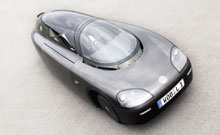 A very impressive 285 mpg, too bad its the size of a motorcycle. And they describe it as looking more like a sports car than a research car... I'm not sure I buy that.
Press Release:
Volkswagen has once again demonstrated its position at the cutting edge of modern technology by presenting the world's most economical road car: the 1-litre or 285 mpg car.
It has an average fuel consumption of just 0.99 litres per 100 kilometres. It manages to combine driving pleasure with a level of fuel consumption never seen before.
The 1-litre car is a vehicle which looks more like a sports car than a typical research vehicle.
It is 3.47 metres long, but just 1.25 metres wide and just over a metre in height. To save weight, it is made of carbon composites and is not painted.
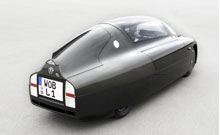
The interior is sportingly simple in design, yet offers enough space for two people.
The concept of the 1-Litre car - four wheels, low height, with two seats in tandem - gives an idea for a possible new family of vehicles, which could cover new requirements ranging from the ultra-economical vehicle, through the low-cost performance sports supercar.
Woods Dual Power - Hybrid Car of 1917
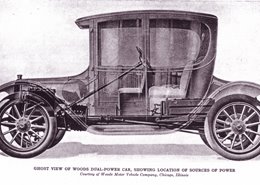 The first hybrid gas electric car did not come out in 1983, but in 1917. The Woods Dual Power was built by the Woods Motor Vehicle Company of Chicago. Because the gas engine was so rough, but supplied more power and electric cars were smoother, but had limited range, the Woods Motor Vehicle Company wanted to supply a car that gave you the best of both worlds.
The best part is, it was a full hybrid (listen up GM) with regenerative braking. The engine was a parallel hybrid that included a 12-hp, 4-cylinder gasoline engine as an auxiliary drive system in addition to the electric drive train. The electric engine could propel the car up to 20 mph. Together with the gas engine, the dual wood power could get up to 35 mph.
The gas engine and electric engine were connected using a magnetic clutch. The gas engine became magnetized when activated (by a lever controlled by the driver). The copper disk was pulled against the flywheel connecting the electric motor to the gas engine.
Only the electric motor could be used while going in reverse. Why? Because the engine had no clutch and so the gas engine had no gears!
The car battery designed for this car was about half the size of the batteries in other electric cars of the time. Once the car got up to 20 mph, the gas engine could be engaged, allowing the electric motor and gas motor to work together. The battery could be recharged or discharged by another lever. Recharging was done by the gas motor (at speeds over 6 mph) or by braking on level ground or when coasting down hills. A conventional brake pedal was only used at speeds of less than 6 mph.
Available for only $2650 (remember this was 1917). Wire wheels were a luxury, costing an extra $25. Or you could 'pimp' your vehicle out for another $100 (paint and trim).
Ultimately, the first hybrid was a commercial failure. It was built only in 1917 and 1918. It was too expensive, too slow, and too difficult to service to be a commercial success.
Want to learn more about this remarkable vehicle? Take a look here or go to the Peterson Automotive Museum in Los Angeles. They have one of only three Woods Dual Power vehicles known to be in existence. There is (reportedly) a 1916 Woods Dual Power (hybrid) in the holdings of the Henry Ford Museum in Dearborn, MI.
I saw a story on the 1917 Woods Dual Power at CNN Money and had to research it further. Yahoo Autos has a history of hybrid electric cars, starting in 1905.
Wednesday, 19 April 2006
Pros and cons of hybrid cars
Hybrid cars can be very beneficial to car drivers everywhere, but they, like every technology, have their own problems that we the consumer should be aware of. So, let's go over the pros and cons of hybrid cars.
Pros:
Higher mpg
Saving money on gas is a possibility for hybrid car owners. Even mild hybrid trucks who improve their mileage from 17 to 19 mpg have made a difference. And if you start talking about getting 50 or 60 mpg, you are really beginning to save money on gas. At the same time, you are making a difference in the dependence we all have on oil and its byproducts. Also, you may just hate going to the pump so often.
Less Pollution
Hybrid cars have lower pollution levels than other cars. When running on their electric motors, hybrid engines are not putting out any of the pollutants we worry about when it comes gas engines. As ranked by American Council for an Energy-Efficient Economy, 3 of the top 12 'Greenest Cars' were hybrid cars.
Better Performance
Hybrid cars can be designed for power, rather than economy. The Honda Accord Hybrid and the Lexus GS450h are good examples of 'performance' hybrids. The electric engine is used to boost the power performance of the gas engine at lower speeds, rather than replacing it.
Hypermiling
Hybrid cars can get better than the EPA rating for mileage. Unlike gas engines, the hybrid is capable of exceeding the EPA rating for mileage on a regular basis with a few simple changes to your driving patterns. These techniques are called hypermiling and allowed a group to get over 100 mpg in a long distance trial of a Toyota Prius.
Tax Breaks
The federal government is offering up to $3400 in a tax credit for those who buy a hybrid car this year. Mind, that's only for the first 60,000 qualifying cars by each manufacturer, so if you're looking to buy a Toyota hybrid and you want to get that tax break, you should buy one this year. Several states are also offering tax breaks to consumers who purchase hybrid cars.
Local Perks
Some states offer HOV access (Virginia and California) to drivers of hybrid cars. Some localities even offer free parking. Some states are looking into tax breaks or may already offer them. Some companies offer money to those who go hybrid. So you should look around for your local perks (Illinois, Pennsylvania, Missouri, etc...)
Cons:
Hybrid Batteries
There are concerns about hybrid batteries. Most of those center around how long they will last and how expensive they are to replace and are these bigger nickel metal hydrid batteries bad for the environment? The truth is these bigger batteries are supposed to be recycled, just as the lead batteries in gas only cars are supposed to be. Also, the batteries are being guaranteed for 8 year (10 if you are in California). But they are very expensive to replace if you do need to do so. A bill for several thousand dollars would come your way if it dies and its not under warantee.
Safety
If you are in an accident with a hybrid car, is that bigger battery a possible danger? High voltage electricy can be dangerous, but manufacturers are making these batteries shut down in an accident. But things can go wrong, which is why some emergency crews are getting special training relating to hybrid car accidents. But otherwise, these cars are just as safe as their counterparts.
Cost
Saving on gas is not enough to make up for a huge initial cost, i.e. the purchase price. When the manufacturer prices the hybrid $3000 more than its gas only counterpart, its hard to justify the initial layout of money. According to a recent study of hybrid cars by Consumer Reports, only two of the six hybrids studied made up for their initial cost (Prius and Civic) in the first five years of ownership. And they did take into account the federal tax credit being offered, (although not the local ones).
Also, you may want to keep in mind that repair costs may be more. Although hybrid cars have been reported to be extremely reliable, if something goes wrong with the electric engine or the 'hybrid' part of the car, you will probably need to take it to your local dealer, who usually charges more for repairs. Of course, this is true whenever a major 'system' in a car goes kaput. On the other hand, some basic maintenance will cost less. For instance, you won't have to change the oil as often.
Conclusion
Just like buying any other car, you need to look into what your needs are and why you are buying it. Did you want a bigger car? Or how about better fuel efficiency or perhaps pollution is your biggest issue? Is price the most important thing? Or how about quality of manufacturing? Hybrids have their own issues, but what it always comes down to when buying an auto is personal choice.
Pros:
Higher mpg
Saving money on gas is a possibility for hybrid car owners. Even mild hybrid trucks who improve their mileage from 17 to 19 mpg have made a difference. And if you start talking about getting 50 or 60 mpg, you are really beginning to save money on gas. At the same time, you are making a difference in the dependence we all have on oil and its byproducts. Also, you may just hate going to the pump so often.
Less Pollution
Hybrid cars have lower pollution levels than other cars. When running on their electric motors, hybrid engines are not putting out any of the pollutants we worry about when it comes gas engines. As ranked by American Council for an Energy-Efficient Economy, 3 of the top 12 'Greenest Cars' were hybrid cars.
Better Performance
Hybrid cars can be designed for power, rather than economy. The Honda Accord Hybrid and the Lexus GS450h are good examples of 'performance' hybrids. The electric engine is used to boost the power performance of the gas engine at lower speeds, rather than replacing it.
Hypermiling
Hybrid cars can get better than the EPA rating for mileage. Unlike gas engines, the hybrid is capable of exceeding the EPA rating for mileage on a regular basis with a few simple changes to your driving patterns. These techniques are called hypermiling and allowed a group to get over 100 mpg in a long distance trial of a Toyota Prius.
Tax Breaks
The federal government is offering up to $3400 in a tax credit for those who buy a hybrid car this year. Mind, that's only for the first 60,000 qualifying cars by each manufacturer, so if you're looking to buy a Toyota hybrid and you want to get that tax break, you should buy one this year. Several states are also offering tax breaks to consumers who purchase hybrid cars.
Local Perks
Some states offer HOV access (Virginia and California) to drivers of hybrid cars. Some localities even offer free parking. Some states are looking into tax breaks or may already offer them. Some companies offer money to those who go hybrid. So you should look around for your local perks (Illinois, Pennsylvania, Missouri, etc...)
Cons:
Hybrid Batteries
There are concerns about hybrid batteries. Most of those center around how long they will last and how expensive they are to replace and are these bigger nickel metal hydrid batteries bad for the environment? The truth is these bigger batteries are supposed to be recycled, just as the lead batteries in gas only cars are supposed to be. Also, the batteries are being guaranteed for 8 year (10 if you are in California). But they are very expensive to replace if you do need to do so. A bill for several thousand dollars would come your way if it dies and its not under warantee.
Safety
If you are in an accident with a hybrid car, is that bigger battery a possible danger? High voltage electricy can be dangerous, but manufacturers are making these batteries shut down in an accident. But things can go wrong, which is why some emergency crews are getting special training relating to hybrid car accidents. But otherwise, these cars are just as safe as their counterparts.
Cost
Saving on gas is not enough to make up for a huge initial cost, i.e. the purchase price. When the manufacturer prices the hybrid $3000 more than its gas only counterpart, its hard to justify the initial layout of money. According to a recent study of hybrid cars by Consumer Reports, only two of the six hybrids studied made up for their initial cost (Prius and Civic) in the first five years of ownership. And they did take into account the federal tax credit being offered, (although not the local ones).
Also, you may want to keep in mind that repair costs may be more. Although hybrid cars have been reported to be extremely reliable, if something goes wrong with the electric engine or the 'hybrid' part of the car, you will probably need to take it to your local dealer, who usually charges more for repairs. Of course, this is true whenever a major 'system' in a car goes kaput. On the other hand, some basic maintenance will cost less. For instance, you won't have to change the oil as often.
Conclusion
Just like buying any other car, you need to look into what your needs are and why you are buying it. Did you want a bigger car? Or how about better fuel efficiency or perhaps pollution is your biggest issue? Is price the most important thing? Or how about quality of manufacturing? Hybrids have their own issues, but what it always comes down to when buying an auto is personal choice.
Lexus GS450h orders exceed targets in first month
Toyota's new Lexus hybrid is exceeding its target within its first month of sales according to a Japanese news report. Toyota had a target of 150 orders in the first month, but has totaled 1,000 cars so far.
Named one of the hottest cars by Forbes, the Lexus GS450 hybrid has an EPA estimated fuel economy of 25 city/28 highway. Of course, this luxury car comes with a luxury price with a base MSRP of $54,900.
First Lexus hybrid off the showroom floor - MSN-Mainichi Daily News
Named one of the hottest cars by Forbes, the Lexus GS450 hybrid has an EPA estimated fuel economy of 25 city/28 highway. Of course, this luxury car comes with a luxury price with a base MSRP of $54,900.
First Lexus hybrid off the showroom floor - MSN-Mainichi Daily News
Subscribe to:
Posts (Atom)