Once again production is falling behind the demand, leading to long waiting lists for the newest generation Prius. And once again, its parts that are limiting how many Prius can be built at any one time. In this case, it's the battery that's put a cap on the number Toyota can produce each month (Source:Battery bottleneck limits Prius output - Automotive News).
The batteries are made by Panasonic EV Energy Co. And they simply can't 'churn out more' batteries than what they've already planned out with Toyota. At 500,000 cars a year, "The new Prius model is selling quite well," Takahiko Ijichi, Toyota senior managing director said.
I can only imagine what the limitation would have been if Toyota had switched to Lithium-Ion, instead of sticking with the Nickel Metal Hydride battery packs. They also wouldn't have been able to cut costs on their battery production.
Battery production is set to increase to 1 million batteries a year by the summer of 2010.
BTW, Ijichi also mentioned the Prius is 'probably in the midlevel of profit' across their line-up. That should be of interest to those who still claim Toyota loses money on the Prius.
Wednesday, 5 August 2009

Cash for Clunkers Numbers
The top three cars purchased through the CARS program so far were the Ford Focus, Honda Civic and Toyota Corolla. Next on the list was the Toyota Prius. The Civic, Escape, and Camry have hybrid versions, but I haven't seen if buyers were opting for the hybrid versions of the vehicles.
83% of the vehicles traded in to be scrapped were trucks and SUVS (not surprising given the maximum mpg values allowed for the trade in). 60% of the vehicles purchased were passenger cars (Source: Cash for Clunkers cars: Small wins big - CNN.com).
The Top 10 Picks for the CARS Program (Source: NYTimes):
1. Ford Focus
2. Honda Civic
3. Toyota Corolla
4. Toyota Prius
5. Ford Escape
6. Toyota Camry
7. Dodge Caliber
8. Hyundai Elantra
9. Honda Fit
10. Chevrolet Cobalt
Overall, the fuel economy increase from the old vehicles has been 61 percent, with the new vehicles getting 25.4 mpg.
The top 10 vehicles being traded in were domestic models (Source: LATimes):
Ford Explorer 2WD and 4WD, Ford F-150 2WD and 4WD, Jeep Cherokee and Jeep Grand Cherokee 4WD, Dodge Caravan, Chevy Blazer 4WD, Chevy Silverado 1500 2WD and Ford Windstar.
Senators are saying the $2 billion bill to extend the Cash for Clunkers program passed by the House is likely to pass the Senate this week. The legislation would transfer the money from an Energy Department loan guarantee program in the economic stimulus package approved in February.
As of 11:30 a.m. Tuesday, 157,000 transactions had been completed across the country and $664 million in federal vouchers spent as part of the CARS program, said Eric Bolton, spokesman for the National Highway Traffic Safety Administration.
83% of the vehicles traded in to be scrapped were trucks and SUVS (not surprising given the maximum mpg values allowed for the trade in). 60% of the vehicles purchased were passenger cars (Source: Cash for Clunkers cars: Small wins big - CNN.com).
The Top 10 Picks for the CARS Program (Source: NYTimes):
1. Ford Focus
2. Honda Civic
3. Toyota Corolla
4. Toyota Prius
5. Ford Escape
6. Toyota Camry
7. Dodge Caliber
8. Hyundai Elantra
9. Honda Fit
10. Chevrolet Cobalt
Overall, the fuel economy increase from the old vehicles has been 61 percent, with the new vehicles getting 25.4 mpg.
The top 10 vehicles being traded in were domestic models (Source: LATimes):
Ford Explorer 2WD and 4WD, Ford F-150 2WD and 4WD, Jeep Cherokee and Jeep Grand Cherokee 4WD, Dodge Caravan, Chevy Blazer 4WD, Chevy Silverado 1500 2WD and Ford Windstar.
Senators are saying the $2 billion bill to extend the Cash for Clunkers program passed by the House is likely to pass the Senate this week. The legislation would transfer the money from an Energy Department loan guarantee program in the economic stimulus package approved in February.
As of 11:30 a.m. Tuesday, 157,000 transactions had been completed across the country and $664 million in federal vouchers spent as part of the CARS program, said Eric Bolton, spokesman for the National Highway Traffic Safety Administration.
Tuesday, 4 August 2009
Where are the Cash for Clunkers Numbers?
Despite rumors on the number of cars sold using the Cash for Clunkers program, there are no numbers yet to back up what or how many have occurred. And that's worrying to the AP:Obama administration withholds data on clunkers - Yahoo! News
I'd be most curious about the difference in fuel economy, not to mention the makes and models of the cars being bought and sold. Ford has stated the CARs program has been extremely helpful for them. But rumors are saying a majority of the cars being bought are from Honda and Toyota.
Quick Update:
Bloomberg has a story on the numbers being released. The CARS program is currently hiring twice as many consultants just to handle the claims being made.
This program is moving so fast, it's hard to keep up with the latest information.
The Associated Press has sought release of the data since last week. Rae Tyson, spokesman for the National Highway Traffic Safety Administration, said the agency will provide the data requested as soon as possible.So, go ahead and do it? Congress is looking to put in $2 billion more into the program. And the program has continued this week, despite possibly being out of money. The least the Obama administration could do is release the numbers they have.
DOT officials already have received electronic details from car dealers of each trade-in transaction. The agency receives regular analyses of the sales data, producing helpful talking points for LaHood, White House spokesman Robert Gibbs and other officials to use when urging more funding.
LaHood said in an interview Sunday he would make the electronic records available. "I can't think of any reason why we wouldn't do it," he said.
I'd be most curious about the difference in fuel economy, not to mention the makes and models of the cars being bought and sold. Ford has stated the CARs program has been extremely helpful for them. But rumors are saying a majority of the cars being bought are from Honda and Toyota.
Quick Update:
Bloomberg has a story on the numbers being released. The CARS program is currently hiring twice as many consultants just to handle the claims being made.
Vehicles made by the three largest U.S. automakers -- General Motors Co., Ford Motor Co. and Chrysler Group LLC --were fewer than half of sales under the program through Aug. 1, according to Transportation Department data obtained today. The companies accounted for 47 percent of the clunkers transactions.That's a good deal of improvement for the cars being traded in, although I hasten to point out 80,000 vehicles is just a drop in the bucket for overall sales. That's about 8% of the sales made in July, for instance. And sales were still down 12% from last year, never mind what they were down from two years ago.
About 80,500 transactions had been logged at the National Highway Traffic Safety Administration, which is administering the program. That doesn’t include the backlog.
Vehicles traded in under the program averaged 15.8 miles per gallon, compared with 25.4 miles per gallon for the new purchases, or a 61 percent improvement, according to the Transportation Department data.
This program is moving so fast, it's hard to keep up with the latest information.
Hybrid Car Sales, July 2009
Hybrid car sales took off in July. Whether it was the Cash for Clunkers (CARs) program or if it was the Prius hitting its stride, the 34,660 units sold was 32.6% better than last July. Cumulative sales for 2009 are still down 27.8%. That makes July, 2009 the fifth best sales month for hybrids ever. Not since May, 2008 have the numbers been this good.
 Probably the biggest news is the Prius in its first full month of sales without limited numbers at dealerships. The third generation Prius sold over 25,000 units in Japan, and over 19,000 units here in the US. Although overall Toyota sales were down 11% from last July, the Prius has to be a bright spot for them.
Ford sales were also way up, due to traffic from the Cash for Clunkers program (according to Ford). Fuel efficiency and hybrids were the mainstays for Ford posting a gain in year-to-year sales for the first time in a long time. Part of that is how badly sales were last July, but not everyone saw a gain (see Toyota), so anything positive for them is good news.
Nissan saw a year on year gain of 44% for the Altima Hybrid. Limited sales of the Altima Hybrid, available in only eight states, makes it hard to interpret their results. But it looks like fuel efficiency and the CARS program were a big bonus for Nissan as well.
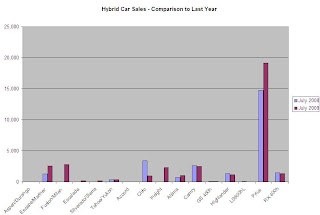 Honda may be the biggest disappointment, as they continue to divert production to Japan for the new Insight. The Civic Hybrid sales were down 71.8%. It seems like the Honda Insight is not competing well against the Prius, but is competing well against its cousin the Civic.
GM saw good gains this month, with the Tahoe/Yukon up 5.7%, while the Sierra/Silverado and Escalade had decent numbers (for them). Although limited in sales, these hybrid SUVs and trucks may be considered luxury vehicles, putting them in a different class for what is good sales figures.

Ford sales were also way up, due to traffic from the Cash for Clunkers program (according to Ford). Fuel efficiency and hybrids were the mainstays for Ford posting a gain in year-to-year sales for the first time in a long time. Part of that is how badly sales were last July, but not everyone saw a gain (see Toyota), so anything positive for them is good news.
Nissan saw a year on year gain of 44% for the Altima Hybrid. Limited sales of the Altima Hybrid, available in only eight states, makes it hard to interpret their results. But it looks like fuel efficiency and the CARS program were a big bonus for Nissan as well.
| Monthly Sales | July 2008 | July 2009 | % Change | ||||
| Make | Model | N | % | N | % | ||
| Ford | Escape/Mariner | 1,265 | 4.8 | 2,543 | 7.3 | 101.0 | |
| Ford | Fusion/Milan | 0 | 0.0 | 2,810 | 8.1 | 0.0 | |
| GM | Escalade | 0 | 0.0 | 167 | 0.5 | 0.0 | |
| GM | Silverado/Sierra | 0 | 0.0 | 180 | 0.5 | 0.0 | |
| GM | Tahoe/Yukon | 351 | 1.3 | 371 | 1.1 | 5.7 | |
| Honda | Accord | 3 | 0.0 | 0 | 0.0 | -100.0 | |
| Honda | Civic | 3,440 | 13.2 | 969 | 2.8 | -71.8 | |
| Honda | Insight | 0 | 0.0 | 2,295 | 6.6 | 0.0 | |
| Nissan | Altima | 715 | 2.7 | 1,030 | 3.0 | 44.1 | |
| Toyota | Camry | 2,645 | 10.1 | 2,509 | 7.2 | -5.1 | |
| Toyota | GS 450h | 40 | 0.2 | 45 | 0.1 | 12.5 | |
| Toyota | Highlander | 1,371 | 5.2 | 1,171 | 3.4 | -14.6 | |
| Toyota | LS600hL | 83 | 0.3 | 28 | 0.1 | -66.3 | |
| Toyota | Prius | 14,785 | 56.6 | 19,173 | 55.3 | 29.7 | |
| Toyota | RX 400h | 1,439 | 5.5 | 1,369 | 3.9 | -4.9 | |
| Total | 26,137 | 34,660 | 32.6 | ||||
| Cumulative Sales | Cumulative 2008 | Cumulative 2009 | % Change | ||||
| Make | Model | N | % | N | % | ||
| Ford | Escape/Mariner | 13,965 | 6.4 | 10,434 | 6.7 | -25.3 | |
| Ford | Fusion/Milan | 2,810 | 1.3 | 8,749 | 5.6 | 211.4 | |
| GM | Escalade | 167 | 0.1 | 1,007 | 0.6 | 503.0 | |
| GM | Silverado/Sierra | 180 | 0.1 | 650 | 0.4 | 261.1 | |
| GM | Tahoe/Yukon | 1,507 | 0.7 | 3,082 | 2.0 | 104.5 | |
| Honda | Accord | 191 | 0.1 | 1 | 0.0 | -99.5 | |
| Honda | Civic | 20,001 | 9.2 | 13,297 | 8.5 | -33.5 | |
| Honda | Insight | 2,295 | 1.1 | 9,819 | 6.3 | 327.8 | |
| Nissan | Altima | 6,605 | 3.0 | 4,204 | 2.7 | -36.4 | |
| Toyota | Camry | 33,041 | 15.2 | 15,516 | 9.9 | -53.0 | |
| Toyota | GS 450h | 504 | 0.2 | 253 | 0.2 | -49.8 | |
| Toyota | Highlander | 14,224 | 6.5 | 7,530 | 4.8 | -47.1 | |
| Toyota | LS600hL | 665 | 0.3 | 185 | 0.1 | -72.2 | |
| Toyota | Prius | 110,615 | 50.9 | 74,924 | 47.8 | -32.3 | |
| Toyota | RX 400h | 10,407 | 4.8 | 7,167 | 4.6 | -31.1 | |
| Total | 217,177 | 156,818 | -27.8 | ||||

GM saw good gains this month, with the Tahoe/Yukon up 5.7%, while the Sierra/Silverado and Escalade had decent numbers (for them). Although limited in sales, these hybrid SUVs and trucks may be considered luxury vehicles, putting them in a different class for what is good sales figures.
Education Proves to be Big Factor for Plug-in Efficiency
The plug-in trials in Seattle have shown a big improvement in fuel economy, going from 51 mpg to 57 mpg in June (Plug-In Hybrids’ Fuel Economy Lookin’ Up In Seattle | Autopia | Wired.com). That's a big improvement, and although still below expectations, it's a factor of two things.
First, the weather improved. Just as with conventional gas engines, the warmer weather helps improve fuel economy. The second big factor is education.
At the prices expected (estimates for the Chevy Volt put it at $40K), customers are going to expect a little magic. Not 51 mpg. Especially since current hybrids that you don't have to plug in can get similar numbers (the current Prius has an EPA rating at 50 mpg).
The plug-in hybrids being used in the Seattle trials are converted 2005 Prius, which were rated at 46 mpg by the EPA.
First, the weather improved. Just as with conventional gas engines, the warmer weather helps improve fuel economy. The second big factor is education.
Driver behavior plays a huge role in maximizing fuel economy in a plug-in hybrid. You’ve got to use a light touch on the accelerator, mind your speed and plug in at every opportunity to keep the battery charged. The plug-ins are divvied up among the city, King County, Seattle City Light, the Port of Seattle and Puget Sound Air Quality (a 14th car in Tacoma wasn’t included in the current data set). Fleet managers have been telling drivers how their driving style impacts fuel economy.And it's one that car makers have got to keep in mind. The success of plug-in vehicles is going to depend on educational efforts by auto makers as they sell the vehicles. If a customer comes in, expecting 100+ mpg, but only get 50 mpg, who's he going to blame for it? What do you think his outlook is going to be like? What do you think the media is going to say about it?
“You hope the message is getting through. It’s an educational effort,” Thomsen said.
At the prices expected (estimates for the Chevy Volt put it at $40K), customers are going to expect a little magic. Not 51 mpg. Especially since current hybrids that you don't have to plug in can get similar numbers (the current Prius has an EPA rating at 50 mpg).
The plug-in hybrids being used in the Seattle trials are converted 2005 Prius, which were rated at 46 mpg by the EPA.
It’s worth noting that the Prius wasn’t designed to be a plug-in hybrid. The biggest problem is the electric motor is too small, so the car relies more heavily on the gasoline engine. Software also limits the top speed in all-electric mode to 34 mpg. Anything more than that and the engine takes over. Cars designed from the ground up to be plug-in hybrids, like the plug-in Prius that Toyota is working on will almost certainly offer far better fuel efficiency than a converted car.
Prius Continues Torrid Pace in Japan and US
Toyota continues to outsell everyone else in Japan with the third generation Prius. Over 25,000 units were sold in Japan for the month of July (Source:Over 25,000 Toyota Prius hybrid cars sold in July › Japan Today: Japan News and Discussion). That's up from the 22,292 units sold in June.
And sales should continue at this pace as long as the production can meet it. Pre-orders have set up a backlog of orders that should take a year to fill in. The tax break and other incentives in Japan have really given the Prius a huge start.
US sales have also seen a big jump, with Toyota selling over 19,000 units in the US. Production can't keep with that sort of demand.
And sales should continue at this pace as long as the production can meet it. Pre-orders have set up a backlog of orders that should take a year to fill in. The tax break and other incentives in Japan have really given the Prius a huge start.
US sales have also seen a big jump, with Toyota selling over 19,000 units in the US. Production can't keep with that sort of demand.
Monday, 3 August 2009
Nissan LEAF

Nissan expects to mass-market the leaf as a global car by 2012. At the unveiling, Nissan CEO Ghosn said Nissan's electric vehicle will get a boost from the interest of governments around the world, adding tougher emissions regulations were expected to increase market share of such cars to 5 percent. Hybrid models only make up about 2 percent of the auto market now, he said.
The Leaf seats five and is said to be slightly longer and wider then the Versa. The electric battery is estimated to cost $10,000 each, so it's hard to imagine right now the car will somehow get down to the price of a conventional gas powered car. One thought is to lease the battery, rather than buying it outright. Nissan would charge consumers at about the same rate as it would cost to fill up with gas.
“Nissan LEAF is a tremendous accomplishment – one in which all Nissan employees can take great pride,” said Nissan President and CEO Carlos Ghosn. “We have been working tirelessly to make this day a reality – the unveiling of a real-world car that has zero – not simply reduced – emissions. It’s the first step in what is sure to be an exciting journey – for people all over the world, for Nissan and for the industry.”

An 80% charge can be set in just under 30 minutes with a quick charger, but you should expect a full charge to take up to eight hours (overnight?). That's at a 200V outlet.
"Our car had to be the world’s first, medium-size, practical EV that motorists could afford and would want to use every day. And that’s what we’ve created. The styling will identify not only Nissan LEAF but also the owner as a participant in the new era of zero-emission mobility," said Masato INOUE, Product Chief Designer.
The design is 'special' according to the press release:

Through bright trim colors inside, Nissan LEAF creates a pleasing and stylish cabin environment. An environmentally friendly “blue earth” color theme originates from the Aqua Globe body color of Nissan LEAF’s introductory model. This theme is carried into the interior through blue dashboard highlights and instrument illumination.
The advanced IT system, connected to a global data center, provides support and information 24 hours a day. The dash monitor displays 'reachable area' which can be quite important when you have a 100 mile range and you need to make sure you can recharge somewhere. The IT system can be used to show a selection of nearby charging stations.
Mobile phones can be used to set air-conditioning and set charging functions, even when the car itself is shut down. And more importantly, a remote-controlled timer can be pre-programmed to charge at certain hours (important when overnight charging can cost you so much less).
Nissan expects electric vehicle production to reach 200,000 units a year by 2012.
Subscribe to:
Posts (Atom)